
Deterministic Orchestrator
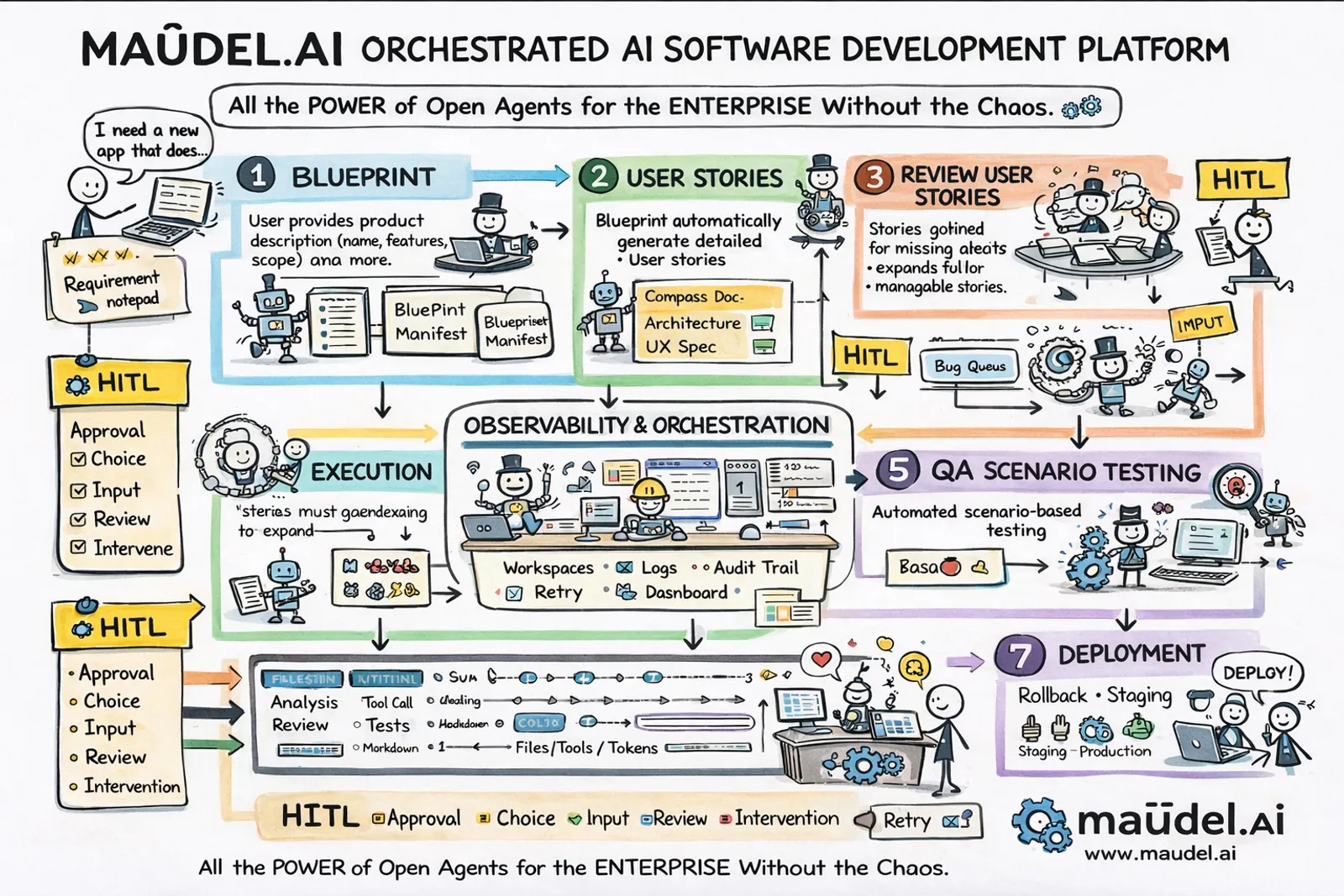
The Deterministic Orchestrator is the governing control system of Maudel. It manages the entire pipeline lifecycle, ensuring predictable execution, reproducibility, and enterprise-grade governance.
What it manages
- Pipeline stage execution
- Task assignment
- Artifact validation
- Dependency resolution
- Quality gates
- Retry / revise / escalate decisions
How it works
Unlike typical agent systems, agents do not decide when work is complete.
Instead:
- Agents submit artifacts
- The orchestrator evaluates readiness
- The orchestrator advances or blocks the pipeline
This separation of concerns ensures that AI creativity remains bounded by deterministic engineering control.
Pipeline Execution Model
Maudel organizes work into twelve deterministic pipeline stages:
1. Blueprint
- Generate NorthStar documents (Compass, Architecture, UX Design, Manifest)
- Structured Q&A flow with gap-intent analysis
- Multi-blueprint registry for modular projects
2. GenStory
- Decompose blueprints into epics and user stories
- Generate acceptance criteria per story
- Map story dependencies and execution order
3. Priming
- Assemble the 9-layer system prompt for the assigned agent
- Load pipeline instructions, stage directives, and reference skills
- Inject upstream context and story-specific instructions
4. GenPlan
- Decompose the story into implementation tasks
- Map task dependencies and identify test requirements
- Produce a structured plan the orchestrator will execute
5. Sandbox
- Create an isolated git worktree for implementation
- Establish the execution environment and workspace
- Pipeline Minder monitors sandbox isolation throughout
6. Implement
- Generate code, migrations, and configuration
- Execute the implementation plan task by task
- Register all artifacts in the traceability graph
7. Validate
- Evaluate implementation against acceptance criteria
- Architecture conformance and security validation
- QA evidence generation and artifact completeness checks
8. Unit Test
- Generate and execute unit tests mapped to acceptance criteria
- Verify code coverage thresholds are met
- Register test results as traceability artifacts
9. CodeReview
- Automated code review against project standards
- Scope compliance verification
- Architecture alignment and security pattern checks
10. GenDocs
- Generate documentation from implementation artifacts
- API documentation, inline comments, and changelog entries
- Ensure documentation traces back to upstream intent
11. SelfLearn
- Extract learnings from the execution run
- Update agent skills and reference knowledge
- Feed patterns into cross-execution improvement loops
12. Merge
- Validate worktree changes merge cleanly to target branch
- Final quality gate evaluation across all artifacts
- Merge execution with full audit trail and traceability linkage
Quality Gates
Each stage has quality gates evaluated by the orchestrator. A gate evaluates signals such as:
- Schema validation
- Artifact completeness
- AI rubric scoring
- Test results
- Dependency resolution
- Architecture alignment
Gate decisions are deterministic, even if some signals are AI-generated. Possible outcomes include: accept, revise, retry, escalate, or block.
Ready to transform your AI engineering?
Governed AI engineering, from idea to deployment.